Friday, April 17, 2009

GH 2009 Tentative Agenda & Activities

Tentative Activities & Agenda

Going Home 2009

The following is what we have worked on for this year Going Home Where We Belong program. All the activities and the entire agenda are tentative and subject to change. Also, some of the activities have yet to be confirmed by our hosts. Ideas and suggestions are still welcome.

1) When

- May 22 through August 15

2) Places

- Mutraw District/ 5th Brigade

- Karenni Refugee Camps

- Mergui/Tavoy District (4th Brigade)

3) Activities

- Refresher Course for districts/brigades leaderships

- Teaching at the New Generation School (Mutraw District)

- Coached Reading Sessions (New Generation School and KnFSP)

- Town-hall Public Meeting (situation updates, informal discussion, and future plans)

- Library and Reading Room

4) Participants

- 5th Brigade & Mutraw District

- 3rd Brigade & Klerlweehtoo District

- KSU, KnFSP, (and maybe a couple more camp based NGOs)

- 4th Brigade & Mergui/Tavoy District

- Going Home Team (USA, Australia, and Singapore)

5) Needs

- More participants who are residing in 3rd countries

- Books & other educational supplies

- Your interest and support

6) Contact Person and address

Please send your contribution – check and supplies to the following person and address:

Neineh Plo

2451 E 10th St., Apt. 421

Bloomington, IN 47408

Our international donors: Please get in touch with me to arrange how you can send your contribution on time.

Should you have any advice, suggestion, ideas to share, especially if they are for this year program, please send them to us by the end of April. We spend the whole year to prepare for a 3-month program and it is extremely inconvenient or often impossible to incorporate the last minute ideas into the program although we appreciate them.

A. So far, we have purchased the following books:

1. Barack Obama Dreams from My Father: A Story of Race and Inheritance, 2004 ed.

2. George Orwell, A Collection of Essays, 1946 ed.

3. George Orwell, 1984 and Animal Farm, 2008 ed.

4. Doris Lessing, Prisons We Choose to Live Inside, 1987 ed.

5. Doris Lessing, A Home for the Highland Cattle and The Antheap, 2003 ed.

6. Eduardo Galeano, We Say No: Chronicles 1963 – 1991, 1992 ed.

7. Gabriel Garcia Marquez, No One Writes to the Colonel and Other Stories, 2005 ed.

8. Hermann Hesse, The Journey to the East, 1956 ed.

9. Ernest Hemingway, The Old Man and the Sea, 1952 ed.

10. Ernest Hemingway, To Have and Have Not, 2003 ed.

11. Abraham Lincoln, Great Speeches (unabridged), 1991 ed..

12. Elie Wisesel, Night, 2006 ed.

13. Naomi Klein, The Shock Doctrine: the Rise of Disaster Capitalism, 2007 ed.

14. Thant Myint-U, The Making of Modern Burma, 2001.

15. Thant Myint-U, The River of Lost Footsteps, 2006.

· Some books we cannot purchase (because they cost over $150 per copy) but are still important, we will be arranging something else so that we could still take them with us for the library.

For example:

- Maung Maung Gyi, Burmese Political Values: The Socio-political Roots of Authoritarianism, 1983.

- U Kyaw Win, U Mya Han, and U Thein Hlaing, Commission to Re-write True History, Nationalities’ Affairs and the 1947 Constitution (Volumes 1 & 2), Univ. Press, Rangoon, 1990.

B. Articles for Analytical Reading (example!)

1. Democracy and Democracy-Support: a new era by Christopher Hobson, Milja Kurki, published on open Democracy News Analysis (http://www.opendemocracy.net).
2. Audacity of Hope by President Barack Obama, a speech to the nation through U.S. Congress on February 25, 2009.
3. The Mind of Winter: Reflections on Life in Exile by Edward Said, Harper’s, September (year?).
4. An Open Mind for a New Army: America’s Best Leaders (Gen. D. Petraeus).

---

Saturday, February 7, 2009

Online Album Updated (Click here!)

Dear Friends:

Please visit an updated online album by simply clicking on the title . Pictures are of Karen New Year celebration in Butho Township, and Commemoration of 60th Karen Revolution Day in Mutraw (Pa-pun) District.

Best,
MO

Tuesday, September 23, 2008

Reflection of Going Home Where We Belong 2008

Reflection on Going Home Where We Belong Program 2008

Although we had to start our Going Home Program for 2008 very late for the reason thoroughly explained by May Oo, we are pleased that we could successfully finish it by mid August 2008. And for this accomplishment, I would like to thank all the members of the Going Home Team, friends and colleagues at KSU, and leaders from Mutraw District/ Brigade 5 and Mergui-Tavoy District/Brigade 4 of Kawthoolei for their enthusiastic corporation and commitment to the Program.

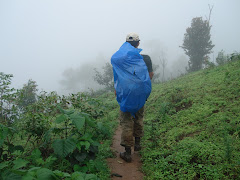
We drove northbound on Thailand’s highways overnight from Bangkok to Mae Sod in the pick-up truck generously lent to us by the Mergui-Tavoy District. After a one-day break and arrangement for further trip in Mae Sod, we drove another seven hours toward Mae Hong Son Province where the homes of the Karenni refugees are. Twenty minutes on the backs of two motorbikes trough muddy and bumpy-jumpy track took us to the heart of a Karenni refugee camp known as Camp 1. Camp 1 is the largest Karenni refugee camp and is also one of the most populated or cramped refugee camps along Thai-Burmese border.

Our mission in Camp 1 was to hold a workshop on Understanding Local Government in cooperation with Karenni Students Union (KSU). The participants were mostly from KSU, Karenni Leadership and Management Course, Social Development Course, and other local organizations. Many of them were young post high school students, pursuing their further education in refugees-run training institutions in the camp. Their participation was quite encouraging although the topic of the workshop did not seem much relevant to their immediate futures. And this is when the need for more Going Home programs by more of us who have been away from home caught my attention again.

Most of the participants were dreaming about resettling in the United States and other so-called third countries whether alone or with their families. Rumor also had it that the US was willing to take at least 15,000 or all of the refugees in the camp of around 20,000 populations, and a significant number from some 6,000 residents in Camp 2, another Karenni refugee camp.

These refugees left their home for many miserable reasons and fled into Thailand for refuge. Now many more reasons have compelled these refugees to seek a safer and better life to wherever circumstance takes them. They have little clue of what lies ahead, and even fewer clue on how they would ever be able to come back or go home once they resettle in another foreign land further away from their home. Probably these are the main reasons why some of them are hesitant to make the decision to resettle. But for some, the home has been left behind, and there is very small hope of returning to it; so why not grab the opportunity that seems to promise a better life in the future? Maybe this opportunity will give us and prepare us with some necessary tools to come home and rebuild it when there is a chance. Exactly. This is not a bad reason to leave home, and it is indeed an important thing that should be done as soon as possible.

Last year the Going Home Team witnessed our people fleeing from home into Thailand due to the war and oppression in our homeland. This year the Team witnessed our people in refugee camps heading to yet other foreign lands due to the gloomy life in refugee camps in Thailand.

We leave our home further and further away from us. We seek better and brighter life. And of course, we all say that we want to go home and be with our people, help them, work with them sometimes in the future. At the same time we know and feel that it is not easy to make this dream a reality. But we won’t dream if we think we can’t make it. Our home misses us. It needs us. And most of all, it welcomes us back. Let’s go home, my Karen/Karenni friends.

Neineh Plo

Co-founder

Going Home Where We Belong

Sunday, August 31, 2008

Going Home 2008 - Greetings

August 31, 2008

Dear Friends of Going Home Where We Belong Program:

Warm greetings. I am pleased to inform you that we had just successfully executed our Going Home 2008 program and that we are now back in school again for another academic year.

Before I go on, I need to acknowledge you and apologize to some of you that our plan did not quite go as we anticipated and therefore there were some miscommunications. The reason for that was that all three of us here at Indiana University did not receive our necessary travel documents on time back from the Homeland Security Department. Therefore although we planned to begin our trip by May 7, we could not actually leave the U.S until July 1. We did apply for our travel document six months ahead and that’s why we did not anticipate that it would have caused us such trouble.

Nevertheless, we are pleased to inform you that the much delayed program went very well although it was severely cut short. There were some minor changes in all the activities, but generally we were able to do most of the things we planned to do with the unwavering cooperation from our colleagues back home. We spent a week with the KSU and other organizations in the Karenni Camp 1 for a workshop on Understanding Local Government, which was originally planned to be a joint program with KSNG. After that, we spent another brief period in Mutraw District (5th Brigade) with our officers from the four northern brigades (1st, 2nd, 3rd, and 5th). Together with our officers, we had a 2-day session of critical discussion on Civilian and Military Administrations with a focused look into the importance of accountability and transparency. Following our time in 5th Brigade, we continued the last part of our Going Home program in the Mergui/Tavoy District (4th Brigade) and spent one full week there for a course on Understanding Local Government: Public Policy Making and Analyzing and Critical Thinking. It was a refresher course for the district leadership and we had the most incredibly enriching time learning and sharing with our leaders.

In the following segments, we would like to update you with the situation back home, about the people, and hope for the future of our peoples and our country.

We would like to thank each and every one of you for your generous contribution to this Going Home Where We Belong and we very much hope that many of you will be able to join us in person in the near future. No matter how far and for how long we have been apart from the beloved land, it remains true that the land is a home we belong to just as much as it belongs to us. Please join us whenever you can and reclaim it.

Sincerely Yours,
Going Home Coordinating Team

Going Home 2008 - Karenni First

The following is a memo on our Going Home Where We Belong – Summer 2008 trip which we started on July 2 and ended on August 20, 2008.

In Karenni Camp 1 (July 7 – 12, 2008)

With the initiative of Karenni Students Union (KSU), Going Home team participated in a workshop entitled Understanding Local Government. The participants were mostly from the Social Development Course, Karenni Leadership and Management Course, and other individuals working with different camp-based organizations.

The intention was to strengthen their understanding of how things are done at local government level, the systems and bureaucracy, and how to make and analyze public policy. The course was more of discussions based on the practical means available in their community. We hoped that discussions on various issues concerning local government or public policy would encourage our participants to take part in public works, or to be interested in public services.

Though we had a great short week with our participants, on the other hand, it was disheartening to see and know that most of our participants, especially young students, were drifting in the dream to go to third-countries. While it is perfectly understandable that every human being searches for green pasture where life offers hope – in their struggle and for their brighter future – and that our peoples are of no exception, just to see them drifting reluctantly simply because the current situation is so bleak even to maintain hope is heartbreaking.

Most of them participated so enthusiastically but the uncertain tomorrows in the refugee camps keep them far from being settled.

We found that it was part of the negative impact created by the resettlement programs currently so popular in the refugee camps along the Thai-Burma border. However, the root-causes of such situation go deeper – the 60 years old unresolved civil war, the continuation of oppression based on ethnicities and religions, and the uncertainties of refugee-camp life.

We would like to thank KSU for organizing the workshop despite the situation that was not so encouraging. Such initiative was a long-shot but necessary one, for we must not give up on believing and hoping that situation must change and we must overcome any and all the difficulties in order for us to rebuild our nation, a nation undergoing desertion on daily basis now because of the unbearable oppressions.

=========

Going Home 2008 - 5th Brigade (Mutraw Dist.)


In 5th Brigade with the Officers from KNLA Northern 4 Brigades
(July 13 – 30, 2008)

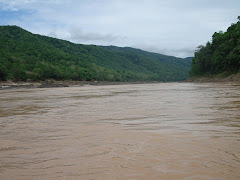
5th Brigade is in Mutraw District of Kawthoolei. The place we were in was called Weh Gyi and was located by the River Salween. We traveled by a boat from Mae Sam Lap for four hours to get to Weh Gyi. It was also a place where the infamous Weh Gyi dam is to be built against the will of the local people, endangering the livelihood and the existence of all the people and living things in the area.

Going Home team was invited to lead a refresher course on Civilian and Military Administrations: accountability, transparency, and checks & balances, an initiative of the 5th Brigade as part of its short and long terms planning to restructure the Organization at district and brigade levels. Participants in this course were the officers from the 1st, 2nd, 3rd, and 5th Brigades. The underlying goal of such course was to bring about a more systematic structure within the organization and to ensure checks and balances between orders of authority. With critical look into the current structure and state of the organization, we had so much vibrant and often heated discussions during our 2-day session. We learned that admitting to our own weaknesses and realizing our inabilities are necessary pains to go through if we are to better ourselves and our struggle. Some of the things that we discussed and learned during this 2-day session would be reflected in the outcomes of, at least, Mutraw District Congress which was held in mid-August 2008.

We would like to thank the Brigadier of 5th Brigade and all colleagues from 1st, 2nd, 3rd, and 5th Brigades – KNLA - for this important opportunity to share and learn from each other. Moreover, we would like to thank all of them for their steadfast understanding of our difficulties in trying to come back home. Although there was expectation that Going Home team would be bigger this year than 2007, we were sad to present them with yet again a small group. Though we as coordinators were disappointed, our hosts - our leaders and colleagues – were more understanding of and ever enduring the imperfect efforts we made.

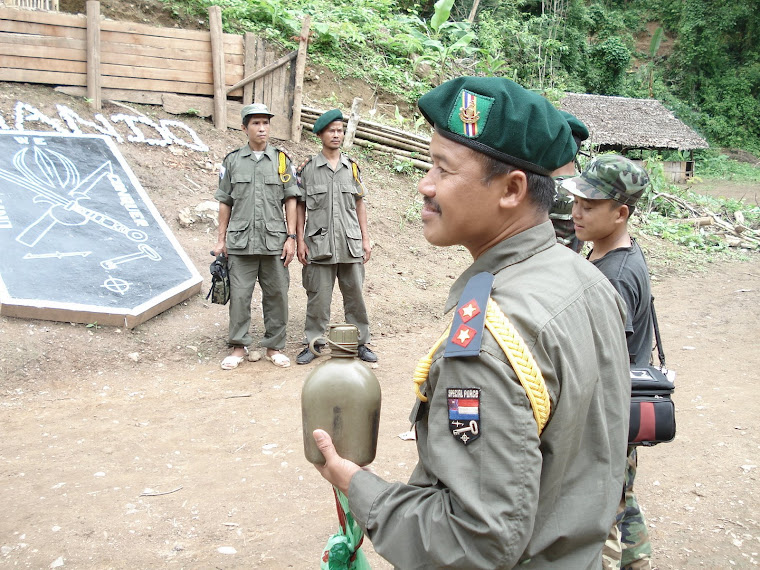
While in the 5th Brigade, we had a chance to observe the commemoration of Karen National Defense Organization Day at the new training site with the Karen soldiers from Commandos School.

It was absolutely encouraging to meet with our officers and soldiers who are working hard, always bettering themselves, and positive-minded. Their energy and unfailing commitment give us hope for a better future even in the midst of all difficulties. But, we all are aware that to gain complete recognition of Karen State, freedom of our peoples, and to realize our rights to peace and prosperity must be a national effort and that it is not merely an effort can be made and achieved by a group of brave men and women. We feel deeply grateful that many of our peoples are making all kinds of enormous sacrifices to carry on the struggle of the Karen people, for a better future of the Karen people and for a peaceful Burma. But, we understand that we all as the people of Burma – Karens and non-Karens alike - have a stake in each other. The wellbeing of the Karens depends on the wellbeing of all others in Burma. We cannot deny that we will rise and fall together as one people, as one nation, in Burma.

Going Home 2008 - In the South (Mergui/Tavoy Dist.)

In Mergui/Tavoy District (4th Brigade – KNLA)

The chairman of Mergui/Tavoy district had requested for a course of Understanding of Local Government for the district leadership and we were glad to have made it this time although it was long delayed. During the intensive period of the course, we studied the functions of local government, specifically how public policies are made and analyzed. There were lots of comparative analyses over the situation on the ground, the ever-changing circumstances, and the practices. The participants included the entire district administration including the chairman and the brigadier of 4th Brigade. Mergui/Tavoy District is one of the most vibrant districts in the KNU and we were greatly encouraged by their enthusiasms and active involvement in the discussions.